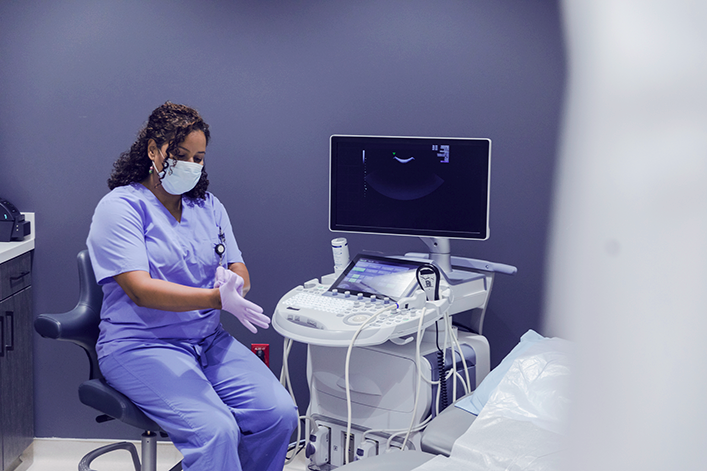
Advancements and Innovation in Women’s Health Technology

Learn how women's healthcare access is improving, thanks to health technology innovations and advancements.
Women's healthcare
Facebook
X
Copy Link

Improving access to women's healthcare.

Women’s healthcare services are in demand. The average age of gynecologists is 51, and most physicians in this field retire before age 60. The potential for a shortage in the field is rising rapidly. 

Thanks to innovations in health technology, women will soon have better access to healthcare and a better understanding of their health. 

Protecting future mothers and current mothers-to-be.

Many women in the U.S. lack access to prenatal and postnatal care, leaving both mother and baby vulnerable to complications like:

  •  Preeclampsia.
  •  Miscarriage.
  •  Post-partum depression.

One of the biggest innovations in women’s healthcare is the ability to track and monitor the patient’s pregnancy from home. Technologies like ultrasounds, baby heart monitors and even app-based fertility tracking have proven to be just as accurate as instruments used in the doctor’s office.

Checkups that once were confined to the four walls of an OB’s office can now be done from the patient’s home. This move to continuous tracking and online communication lessens the risk for complications, including premature birth.

These devices even relay the information gathered back to the doctor for diagnosis and treatment. Organizations implementing these tools may see greater demand for:

  • Care outside of traditional office hours.
  • Remote treatment and intervention.

How will facilities manage these new demands? Cutting-edge hospitals are obtaining support from part-time or remote physicians to smooth demand and prevent burnout in their existing team.

New possibilities for parenthood.

Current advancements not only improve patient care, but also patient outcomes for both the mother and the child.

New surgical advancements mean that women who experience infertility due to cancer or other complications now have more options for IVF, including 3-D printed placenta membranes and better cryogenic egg preservation.

Women can even opt for a “womb replacement,” the total biological or lab-created reconstruction of uterine organs that allow a mother to carry a baby to term – something previously thought impossible.

Advancements like womb replacement require highly trained physicians to keep up-to-date with new technology. If a central focus of your facility is maintaining or growing market share in women’s health, consider how Baylor Scott & White Health invested in the next phase of research.

What's next for women's healthcare?

The medical advances that allow for the better care of women’s health are becoming more and more accessible to providers.

However, 49 percent of counties in the U.S. don’t have an OB/GYN – leaving almost 10 million women without the healthcare they need. Technologies like telehealth and app-based services have helped bridge the gap, but it’s only a start.

The future of women’s healthcare will depend on the adaptability of facilities and advancements within the gynecology field.

Sources: Baylor, Scott & White Health, Contemporary OBGYN, Journal of Women’s Health, MDedge, Medgadget, Science Daily

Learn how technology is impacting women's health care delivery.

Copy Link

Keep Reading

000001422_DoctorOnPhone
Locum Tenens Agency Comparison Checklist: What to Evaluate Before You Sign 
Comparing locum tenens agencies? Use this clinician checklist to evaluate credentialing, transparency, and support before you sign.
000000529_MeasuringChildHeightTeal
How to Validate Workforce Supply Before Expanding Healthcare Services
Understand workforce feasibility as a diligence-stage requirement equivalent to demand forecasting, payer analysis, and facility readiness.
Exterior of multi-story hospital building with row of square windows
Locum Tenens Staffing Strategy for Multi‑Site Health System Growth 
Staffing volatility is unavoidable. Revenue loss doesn't have to be. Learn how locum tenens helps safeguards capacity, continuity, and margin.
000000543_AdministerAnestethisia
A Shortage in Anesthesiologists Is Coming​
Facing a critical shortage of anesthesiologists, the healthcare industry must adapt. Explore how CRNAs could provide much-needed relief.
000001422_DoctorOnPhone
Locum Tenens Agency Comparison Checklist: What to Evaluate Before You Sign 
Comparing locum tenens agencies? Use this clinician checklist to evaluate credentialing, transparency, and support before you sign.
000000529_MeasuringChildHeightTeal
How to Validate Workforce Supply Before Expanding Healthcare Services
Understand workforce feasibility as a diligence-stage requirement equivalent to demand forecasting, payer analysis, and facility readiness.
Exterior of multi-story hospital building with row of square windows
Locum Tenens Staffing Strategy for Multi‑Site Health System Growth 
Staffing volatility is unavoidable. Revenue loss doesn't have to be. Learn how locum tenens helps safeguards capacity, continuity, and margin.
000000543_AdministerAnestethisia
A Shortage in Anesthesiologists Is Coming​
Facing a critical shortage of anesthesiologists, the healthcare industry must adapt. Explore how CRNAs could provide much-needed relief.

Connect With Us

Need licensing support? Ask our experts.

Connect With Us

Federal facts for you.

We are a Federal Supply Schedule Contract holder. 

Federal Supply Schedule (FSS) Contract: 36F79723D0086, Professional and Allied Healthcare Staffing, effective March 15, 2023, through March 14, 2028.

NAICS Codes:
  • 561320: Temporary help services. 
  • 621111: Offices of physicians. 
  • 621112: Offices of physicians, mental health specialists. 
  • 621399: Offices of all other miscellaneous health practitioners. 
  • 621330: Offices of mental health practitioners.

Privileging.

Once you and our client agree to move forward with your assignment, our privileging team will assist you and the client in gathering information required by the healthcare facility to grant clinical privileges.

1

We contact the facility’s Medical Service Office (MSO) for their application and requirements.

2

We will assist you by pre-populating the facility’s application and sending to the MSO.

3

We will assist the MSO by following up on requested items.

4

MSO will grant privileges based on your training and experience, and you will be able to start your assignment.

Headshot photo of Maggie Youmans

Maggie Youmans

Executive Vice President

As Executive Vice President, Maggie Youmans leads specialty divisions, Sales Development, and the Enterprise and VMS teams. With more than 14 years of healthcare staffing leadership experience, she drives sales and recruiting strategy, develops high-performing leaders, and advances initiatives that support growth and customer success.  

A recognized voice in healthcare staffing, Maggie has served as a panelist at the Staffing Industry Analysts Healthcare Staffing Summit and contributed workforce planning insights to Becker’s Hospital Review. Her leadership experience spans specialty, enterprise, and VMS/MSP business lines, giving her a broad perspective on workforce strategy and organizational growth.  

Maggie earned dual BBA degrees in Marketing and Management from the University of Georgia and graduated magna cum laude. Outside of work, Maggie loves traveling, exploring new destinations, restaurants, and experiences with her husband and daughter.  

Connect with Maggie on LinkedIn.