
Women’s Healthcare Demands by State

Learn women's healthcare demands by state and discover how technology is combatting demand in obstetrics and gynecology.
OBGYN Womens Healthcare
Facebook
X
Copy Link

How technology is proving a temporary solution to increased demand.

Providers are struggling to keep up with patient demand for care – especially obstetrics and gynecology physicians. In 2020, the need for OB/GYNs grew by 6 percent or 2,090 full-time providers. That translates to overworked staff in your hospital, but technology does offer some solutions.

Forty-nine percent of counties in the United States don’t have an obstetrician or a gynecologist at all, which leaves 10 million women in the U.S. without care.

Demand for women’s health care is expected to increase in states like Texas and Florida. These are states where the population growth forecast is high and the number of licensed providers is already below adequate levels. Additional demand may come from Hispanic women, as well as minorities like American Natives, Pacific Islanders and Alaskan Natives who live in remote or underserved areas of the country.
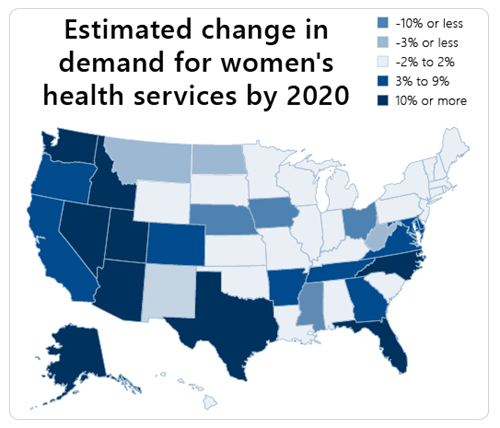
estimated change in demand for women's healthcare by state 2020

No hospital or group has one definitive solution for the obstetrics and gynecology physician shortage problem. But technology might have a short-term answer. Mobile doctors’ offices are becoming popular as providers look to extend their reach to newer patients and lower the costs of clinical healthcare.

OhioHealth implemented Wellness on Wheels (WOW), bringing care to 3,500 women and children, regardless of their ability to pay. Through WOW, the infant mortality rate is 5.2 per 1,000 live births – a number lower than the nationwide rate.

Pregnancy-monitoring virtual visits are in use by some clinics, whereby women utilize home monitoring supplies to track fetal heart rate, maternal blood pressure and fundal height. Outcomes have been similar between traditional prenatal care and telemedicine prenatal visits.

Sources: MobileODT, National Institutes of Health, OhioHealth.

See how locum tenens can help your facility combat staffing shortages and impact your bottom line.


Copy Link

Keep Reading

000000529_MeasuringChildHeightTeal
How to Validate Workforce Supply Before Expanding Healthcare Services
Understand workforce feasibility as a diligence-stage requirement equivalent to demand forecasting, payer analysis, and facility readiness.
Exterior of multi-story hospital building with row of square windows
Locum Tenens Staffing Strategy for Multi‑Site Health System Growth 
Staffing volatility is unavoidable. Revenue loss doesn't have to be. Learn how locum tenens helps safeguards capacity, continuity, and margin.
000000543_AdministerAnestethisia
A Shortage in Anesthesiologists Is Coming​
Facing a critical shortage of anesthesiologists, the healthcare industry must adapt. Explore how CRNAs could provide much-needed relief.
000001258_YoungWomanInTherapy (1)
Why Are Average Psychiatrist Salaries Growing?
Psychiatrist salaries are still rising, but growth is moderating. Explore 2026 pay trends, shortages, and how locum tenens is reshaping compensation and strategy.
000000529_MeasuringChildHeightTeal
How to Validate Workforce Supply Before Expanding Healthcare Services
Understand workforce feasibility as a diligence-stage requirement equivalent to demand forecasting, payer analysis, and facility readiness.
Exterior of multi-story hospital building with row of square windows
Locum Tenens Staffing Strategy for Multi‑Site Health System Growth 
Staffing volatility is unavoidable. Revenue loss doesn't have to be. Learn how locum tenens helps safeguards capacity, continuity, and margin.
000000543_AdministerAnestethisia
A Shortage in Anesthesiologists Is Coming​
Facing a critical shortage of anesthesiologists, the healthcare industry must adapt. Explore how CRNAs could provide much-needed relief.
000001258_YoungWomanInTherapy (1)
Why Are Average Psychiatrist Salaries Growing?
Psychiatrist salaries are still rising, but growth is moderating. Explore 2026 pay trends, shortages, and how locum tenens is reshaping compensation and strategy.

Connect With Us

Need licensing support? Ask our experts.

Connect With Us

Federal facts for you.

We are a Federal Supply Schedule Contract holder. 

Federal Supply Schedule (FSS) Contract: 36F79723D0086, Professional and Allied Healthcare Staffing, effective March 15, 2023, through March 14, 2028.

NAICS Codes:
  • 561320: Temporary help services. 
  • 621111: Offices of physicians. 
  • 621112: Offices of physicians, mental health specialists. 
  • 621399: Offices of all other miscellaneous health practitioners. 
  • 621330: Offices of mental health practitioners.

Privileging.

Once you and our client agree to move forward with your assignment, our privileging team will assist you and the client in gathering information required by the healthcare facility to grant clinical privileges.

1

We contact the facility’s Medical Service Office (MSO) for their application and requirements.

2

We will assist you by pre-populating the facility’s application and sending to the MSO.

3

We will assist the MSO by following up on requested items.

4

MSO will grant privileges based on your training and experience, and you will be able to start your assignment.

Headshot photo of Maggie Youmans

Maggie Youmans

Executive Vice President

As Executive Vice President, Maggie Youmans leads specialty divisions, Sales Development, and the Enterprise and VMS teams. With more than 14 years of healthcare staffing leadership experience, she drives sales and recruiting strategy, develops high-performing leaders, and advances initiatives that support growth and customer success.  

A recognized voice in healthcare staffing, Maggie has served as a panelist at the Staffing Industry Analysts Healthcare Staffing Summit and contributed workforce planning insights to Becker’s Hospital Review. Her leadership experience spans specialty, enterprise, and VMS/MSP business lines, giving her a broad perspective on workforce strategy and organizational growth.  

Maggie earned dual BBA degrees in Marketing and Management from the University of Georgia and graduated magna cum laude. Outside of work, Maggie loves traveling, exploring new destinations, restaurants, and experiences with her husband and daughter.  

Connect with Maggie on LinkedIn.